- CAS
- Purity
- 4233-33-4
- 99%

Location:Home > Pharmaceutical Intermediates
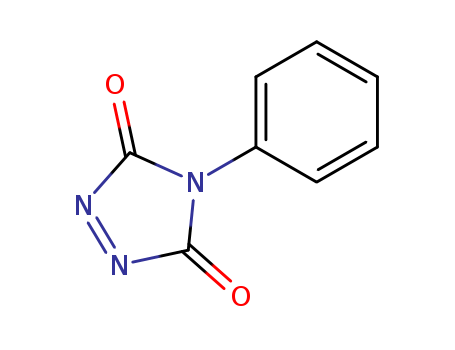
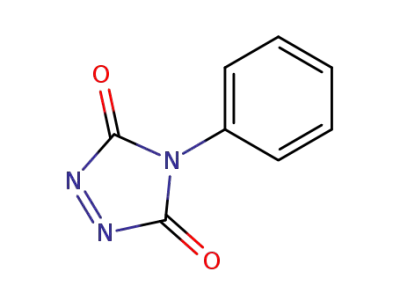
Quality products?make an important contribution to long-term revenue and profitability. Quality Factory Sells Top Purity 99% 4-PHENYL-1,2,4-TRIAZOLINE-3,5-DIONE 4233-33-4 with Safe Delivery
4-Phenyl-1,2,4-triazoline-3,5-dione may be used as a derivatizing reagent for the determination of trace levels of 25-hydroxyvitamin D and its C-3 epimer in biological samples and cholecalciferol (vitamin D3) in fortified infant formula, milk and milk powder using liquid chromatography–tandem mass spectrometry (LC–MS/MS)technique.
(1R,8S)-4,15-dimethyl-11-phenyl-9,11,13-triazatetracyclo[6.5.2.02,7 .09,13 ]pentadeca-2,4,6,14-tetraene-10,12-dione

4-Phenyl-1,2,4-triazolidine-3,5-dione

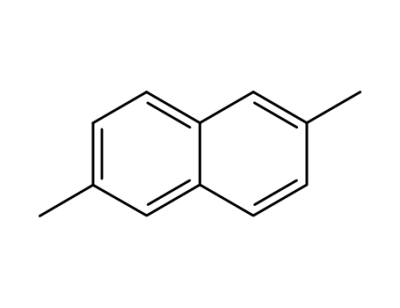
2.6-dimethylnaphthalene
| Conditions | Yield |
|---|---|
|
at 20 ℃;
Equilibrium constant;
Thermodynamic data;
Kinetics;
Activation energy;
|
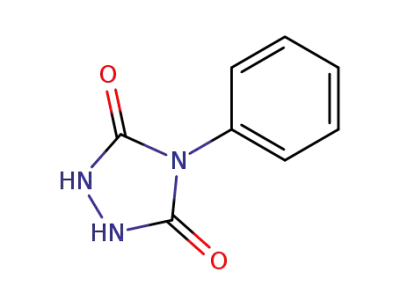
4-Phenylurazole
4-Phenyl-1,2,4-triazolidine-3,5-dione
| Conditions | Yield |
|---|---|
|
With
tetrabutylammonium periodite;
In
acetone;
at 20 ℃;
for 0.5h;
|
100%
|
|
With
SiO2-supported HNO3;
In
dichloromethane;
at 20 ℃;
for 0.583333h;
chemoselective reaction;
|
99%
|
|
With
chlorine;
In
ethyl acetate;
for 18h;
|
98%
|
|
With
tetrachlorosilane; silica gel; sodium nitrite;
In
dichloromethane;
at 20 ℃;
for 3h;
|
98%
|
|
With
ICl supported on silica gel;
In
dichloromethane;
at 20 ℃;
for 0.166667h;
|
98%
|
|
With
aluminum(III) nitrate nonahydrate;
In
dichloromethane;
at 20 ℃;
for 2h;
|
98%
|
|
With
guanidine nitrate;
In
dichloromethane;
at 20 ℃;
for 0.75h;
|
98%
|
|
With
ammonium nitrate; aluminum(III) hydrogen sulfate;
In
dichloromethane;
at 20 ℃;
for 0.666667h;
|
98%
|
|
With
aluminium trichloride; benzyltriphenylphosphonium chlorate;
In
dichloromethane;
at 20 ℃;
for 0.25h;
|
97%
|
|
With
1,3-dibromo-5,5-dimethylimidazolidine-2,4-dione;
In
dichloromethane;
at 20 ℃;
for 2h;
|
97%
|
|
With
sodium hydrogen sulfate; silica gel; sodium nitrite;
In
dichloromethane;
at 20 ℃;
for 1h;
|
96%
|
|
With
hydrogensulfate; silica gel; sodium nitrite;
In
dichloromethane;
at 20 ℃;
for 2h;
|
96%
|
|
With
1,3,4,6-tetrachloro-3α,6α-diphenyl glycoluril;
In
dichloromethane;
at 20 ℃;
for 1h;
|
96%
|
|
With
aluminum (III) chloride; benzyltriphenylphosphonium nitrate;
In
dichloromethane;
for 0.5h;
|
96%
|
|
With
[bis(acetoxy)iodo]benzene;
In
dichloromethane;
for 0.25h;
Ambient temperature;
|
95%
|
|
With
potassium dichromate; aluminium trichloride;
for 0.05h;
|
95%
|
|
With
silica gel; zirconium(IV) chloride; 1,4-diazabicyclo[2,2,2]octane-N,N′-dioxide;
In
dichloromethane;
at 20 ℃;
for 1h;
|
95%
|
|
With
1,1'-(ethane-1,2-diyl)dipyridinium bistribromide; water;
In
dichloromethane;
at 20 ℃;
for 0.5h;
|
95%
|
|
With
poly(ethylene glycol) impregnated with dinitrogen tetroxide;
In
dichloromethane;
at 20 ℃;
for 0.5h;
|
95%
|
|
With
nitrourea;
In
dichloromethane;
at 20 ℃;
for 1h;
|
95%
|
|
With
magnesium hydrogen sulfate; silica gel; sodium nitrite;
In
dichloromethane;
at 20 ℃;
for 1h;
|
94%
|
|
With
benzyltriphenylphosphonium peroxymonosulfate;
aluminium trichloride;
at 20 ℃;
for 0.166667h;
grinding;
|
94%
|
|
With
Oxone; silica gel; sodium nitrite;
In
dichloromethane;
at 20 ℃;
for 1.5h;
|
94%
|
|
With
chromium (VI) oxide; 1-n-butyl-3-methylimidazolim bromide;
at 20 ℃;
for 1.5h;
|
94%
|
|
With
calcium hypochlorite;
In
dichloromethane;
at 20 ℃;
for 0.25h;
|
92%
|
|
With
KMnO4/alumina;
at 20 ℃;
for 0.133333h;
|
90%
|
|
With
dinitrogen tetraoxide;
In
dichloromethane;
at 0 ℃;
|
86%
|
|
With
silica gel; iodic acid; sodium nitrite;
In
dichloromethane;
at 20 ℃;
for 1.5h;
|
86%
|
|
With
dihydrogen peroxide;
at 70 ℃;
for 3h;
|
84%
|
|
With
N-Bromosuccinimide;
In
dichloromethane;
at 0 ℃;
for 0.333333h;
|
82%
|
|
With
n-propylsilica kryptofix 21-supported dinitrogen tetroxide;
In
dichloromethane;
at 20 ℃;
|
82%
|
|
With
melamine-(H2SO4)3; C3H6N6*3HNO3;
In
neat (no solvent);
Green chemistry;
|
81%
|
|
With
oxalic acid; silica gel; sodium nitrite;
In
dichloromethane;
at 20 ℃;
for 1h;
|
80%
|
|
With
trichloroisocyanuric acid;
In
dichloromethane;
at 20 ℃;
for 0.5h;
|
74%
|
|
With
iodosylbenzene;
In
ethyl acetate;
at 25 ℃;
for 4h;
Darkness;
Inert atmosphere;
|
65%
|
|
With
tert-butylhypochlorite;
In
ethyl acetate;
at 20 ℃;
for 1.66667h;
Inert atmosphere;
|
38%
|
|
With
tert-butylhypochlorite;
|
|
|
With
perchloric acid; sodium perchlorate;
In
acetonitrile;
at 0 ℃;
electrolyse, Pt-electrode;
|
|
|
With
benzeneseleninic anhydride;
In
tetrahydrofuran;
for 0.0666667h;
Yield given;
Ambient temperature;
|
|
|
With
tert-butylhypochlorite;
In
dichloromethane;
at 0 ℃;
|
|
|
With
tert-butylhypochlorite;
In
acetone;
at -60 ℃;
|
|
|
With
dinitrogen tetraoxide; sodium sulfate;
In
dichloromethane;
at 0 ℃;
|
|
|
With
tert-butylhypochlorite;
In
ethyl acetate;
at 15 - 20 ℃;
for 0.666667h;
|
65.6 g
|
|
With
tert-butylhypochlorite;
In
acetone;
|
|
|
With
tert-butylhypochlorite;
In
ethyl acetate;
at 0 ℃;
for 0.0833333h;
|
|
|
With
tert-butylhypochlorite;
In
acetone;
|
|
|
In
sulfuric acid; acetonitrile;
Electrolysis;
|
|
|
With
tert-butylhypochlorite;
In
ethyl acetate;
at 0 ℃;
for 0.166667h;
|
|
|
With
[NO(1+)*18-crown-6*H(NO3)2(1-)]; silica gel;
In
dichloromethane;
at 20 ℃;
|
|
|
With
N,N,2,3,4,5,6-heptachloroaniline;
In
dichloromethane;
at 20 ℃;
for 1h;
|
|
|
With
ferric nitrate;
|
|
|
With
tert-butylhypochlorite;
In
dichloromethane;
at 0 - 20 ℃;
for 2h;
|
|
|
With
dinitrogen trioxide; dinitrogen tetraoxide; Nitrogen dioxide;
In
dichloromethane;
at 0 - 5 ℃;
for 0.5h;
|
|
|
With
tert-butylhypochlorite;
|
|
|
pH=2;
pH-value;
Solvent;
Kinetics;
Electrochemical reaction;
aq. phosphate buffer;
|
|
|
With
calcium hypochlorite; sodium sulfate;
In
dichloromethane;
at 20 ℃;
for 2h;
|
The CAS number of 4-PHENYL-1,2,4-TRIAZOLINE-3,5-DIONE is 4233-33-4.
More information of 4-PHENYL-1,2,4-TRIAZOLINE-3,5-DIONE 4233-33-4 are:
|
CAS?Number |
4233-33-4 |
|
Density |
1.471 g/cm3 |
|
Melting Point |
165-170 °C (dec.)(lit.) |
|
Boiling Point |
263.812 °C at 760 mmHg |
|
Flash Point |
113.35 °C |
|
Vapor Pressure |
0.0101mmHg at 25°C |
|
Refractive Index |
1.701 |
|
HS CODE |
29339900 |
|
PSA |
62.10000 |
|
LogP |
1.13500 |
|
Pka |
-1.71±0.20(Predicted) |
Synonyms?for?4-PHENYL-1,2,4-TRIAZOLINE-3,5-DIONE 4233-33-4:4-Phenyl-1,2,4-triazoline-3,5-dione;4-Phenyl-3H-1,2,4-triazole-3,5(4H)-dione;3H-1,2,4-Triazole-3,5(4H)-dione,4-phenyl-;4-phenyl-1,2,4-triazole-3,5-dione;
The chemical formula of ?4-PHENYL-1,2,4-TRIAZOLINE-3,5-DIONE is?C8H5N3O2 which containing 8 Carbon atoms,5 Hydrogen atoms,3 Nitrogen atoms and 2 Oxygen atoms,and the molecular weight of??4-PHENYL-1,2,4-TRIAZOLINE-3,5-DIONE?is 175.147.
4-Phenyl-1,2,4-triazoline-3,5-dione, also known as Cookson reagent, is a strong dienophile that forms a stable Diels-Alder adduct quantitatively within a short time and under mild conditions. It is commonly used as a protecting group of the diene moiety for the synthesis of vitamin D3 (VD3)-related compounds and is characterized as a red solid.
InChI:InChI=1/C8H5N3O2/c12-7-9-10-8(13)11(7)6-4-2-1-3-5-6/h1-5H
Relevant articles related to 4-PHENYL-1,2,4-TRIAZOLINE-3,5-DIONE:
|
Article |
Source |
|
Role of Heteroatoms in Diastereofacial Control in Cycloaddition to a Dissymmetric Cyclohexa-1,3-diene Moiety in a Polycyclic Framework. Remarkable Stereodirecting Influence of Distal Protective Groups |
Mehta, Goverdhan,Uma , p. 1685 - 1696 (2000) |
|
Diazacyclobutene derivatives and methods of synthesis thereof |
- Page/Page column 12, (2021/01/17) |
Hebei Ruiyao Biological Technology Co., Ltd. is a quality supplier of 4-PHENYL-1,2,4-TRIAZOLINE-3,5-DIONE. Our main goal is customer satisfaction. Contact us to negotiate the best price for your business on 4-PHENYL-1,2,4-TRIAZOLINE-3,5-DIONE 4233-33-4.